Learning materials / Facilitator guide
75-minute session · guide-training
Kind training lab: small steps and reliable pauses
Adult caregivers or supervised older learners; all practical tasks use people, objects or stuffed toys.
Session outcomes
- Rehearse marker timing without placing demands on a cat.
- Build a carrier ladder with separate entry, door and movement steps.
- Demonstrate a stop response during a cooperative-care role-play.
Session flow
5 minutes
Set the welfare goal
- Say: ‘Our job is to make our signals clear and our stopping decisions reliable. We are not testing a cat’s obedience.’
- Confirm that the session uses no live cats, no withheld food, no forced touch and no timed animal-performance challenge.
10 minutes
Reward and goal workshop
- Read: ‘A caregiver wants the cat to behave at the vet and assumes every cat wants petting.’ Ask learners to rewrite the goal as one observable preparatory action.
- Use ws-training-01 to propose two possible rewards and explain how the cat’s response, care plan and current comfort would guide the choice.
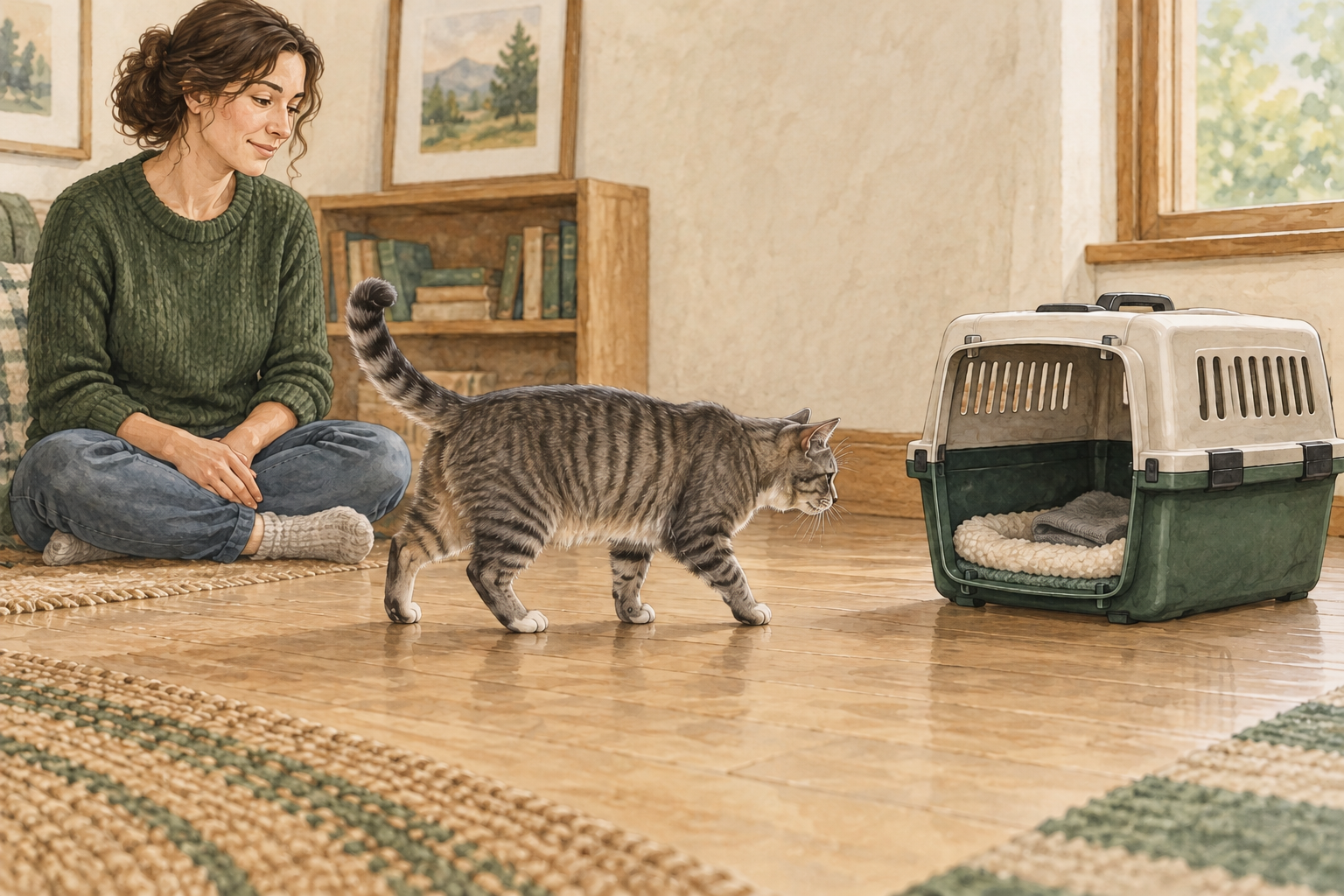
- Model a useful goal: ‘comfortably approaches the open carrier.’ Make clear that the model is a planning example, not a claim about a real cat.
15 minutes
Human-only timing lab
- One person moves a token toward a drawn circle; the learner marks when it reaches the circle and places a second token in a reward cup. Solo learners can move an object with one hand and use the other for the reward token.
- Run a few slow rounds, then stop to discuss: Was the reward prepared? Was the marker early, late or clear? Do not score speed.
- Swap roles if desired. Use ws-training-02 to change one part of the setup and rehearse again.
- Explain that learning a marker and asking for a behavior are separate steps. A startling signal is a reason to stop, not repeat louder.
15 minutes
Carrier ladder design
- Read the fictional case: ‘Fern can look at the open carrier from across the room but backs away when food is placed inside. An appointment is planned, and the caregiver wants to close the door today.’
- Groups use ws-training-04 to choose an easier starting point and explicitly keep the door open.
- Then use ws-training-05 to separate possible future door movement, closure duration, lifting and travel. Ask which prerequisites are missing.
- Debrief that a deadline does not create training readiness. For a required visit, the caregiver should ask the clinic for safe transport help rather than rush the ladder.
15 minutes
The pause-button role-play
- Use a stuffed toy or a partner’s freely offered sleeve to rehearse a familiar-touch sequence; human permission is required and anyone may opt out.
- The observer reveals a role card before the planned touch: comfortable, turns away, leaves or equipment slips.
- The learner must describe and enact the appropriate stop or pause. On withdrawal cards, stopping before contact is the successful outcome.
- Use ws-training-06 to record signal, caregiver response and one question for a qualified professional before adding a care procedure.
10 minutes
Troubleshooting clinic on paper
- Present three planning problems: marker arrives after the action; carrier entry is followed by surprise closure; learner wants to restrain the cat on the mat to finish.
- For each, ask for a smaller or clearer alternative. Use the answer notes below rather than improvising medical or aggression advice.
- Have pairs explain how they would know their new plan remained voluntary.
5 minutes
Reflection and feedback
- Ask every learner to name one skill they can rehearse without their cat and one stop signal they will respect.
- Collect optional anonymous feedback about unclear wording, not claims of training success. Identify one module for review using the course’s self-reflection rubric.
Discussion prompts
- What is the smallest observable action in your goal?
- What changes when the cat leaves, and how will your plan honor that?
- Which variables have accidentally been combined in the carrier plan?
- How would you get timely veterinary care if training is incomplete?
Facilitator answer notes
- ‘Behave at the vet’ is too broad. A voluntary approach or one comfortable preparatory step is observable and limited.
- Timing difficulty is first a caregiver-mechanics problem; rehearse without the cat and prepare delivery.
- Fern’s response supports an easier outside-carrier step. It does not justify food deprivation, pushing, blocking or surprise closure.
- A mat is not permission for restraint. Withdrawal ends the optional touch attempt.
- A reward is defined by the cat’s response. Some cats value suitable food, some play or welcomed contact; do not assume a universal favorite.
- For the three troubleshooting cases: simplify timing; separate entry from closure; honor departure and ask for professional help with necessary care.
Adaptations
- Use a quiet spoken marker instead of a clicker. Learners with sensory needs can work from written sequencing cards.
- Offer seated practice, larger tokens or a helper; dexterity differences do not reduce learning credit.
- Allow solo paper planning or observation in place of partner touch.
- Do not require access to a carrier, treats or a cat to complete the learning tasks.
Welfare and facilitation boundaries
- No live-animal demonstration or grooming procedure is required.
- No forced confinement, restraint, aversive sound, scruffing, punishment or withholding essentials.
- Medication and individualized handling plans belong with the veterinary team. Practice does not justify delaying care.
Facilitator notes
- Observe whether a learner stops on a withdrawal card; this matters more than fluent terminology.
- Repeated errors about closure or restraint require revised examples and another explanation, not more difficult assignments.
- Record curriculum version and module when noting feedback so later edits can be evaluated honestly.
Session sources
- How Cats LearnFelineVMA
- Positive Reinforcement Techniques to Prevent Unwanted BehaviorsFelineVMA
- Cat Training Techniques for CaregiversFelineVMA
- Cat training 101AAHA
- Getting Your Cat to the Veterinarian: Reducing the Stress of Veterinary VisitsAAFP / ISFM (hosted by FelineVMA)
- Choosing the Perfect Cat CarrierFelineVMA / Cat Friendly Homes
- How to Pet & Handle CatsFelineVMA / Cat Friendly Homes