Everyday care & enrichment / Lesson
care-02 · 30 min study time
Build a home with places to hide, rest and choose
Turn the five environmental needs into a workable room plan, using safe, low-cost changes before buying equipment.
Lesson duration includes reading, planning, worksheets and reflection. Optional cat practice is brief, voluntary and stops at the first sign of discomfort; the listed minutes are never a confinement or handling target.
Pause and recall
Which resource is present but hard for your cat to reach?
Think in functions before products
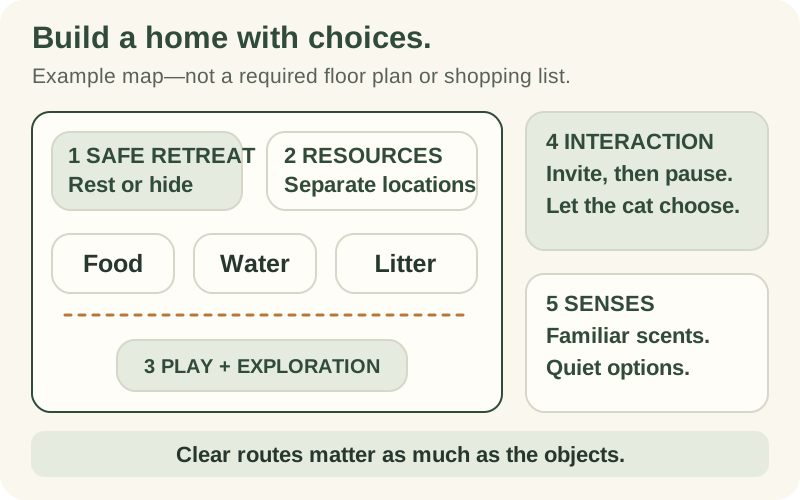
A cat-friendly home provides protected resting places, separated resources, opportunities for play, predictable friendly interaction and consideration for the cat’s senses. Start with the question ‘What can my cat do here?’ rather than ‘What must I buy?’ A clean sturdy cardboard hide and familiar bedding can provide a useful choice. A new expensive tower does little if it wobbles, is inaccessible or stands where another animal can block the way.
Map routes as well as objects
Sketch the space from a cat’s point of view. Draw the doorways between the bed, water, food and litter box. Note noisy equipment, visiting children, dogs and narrow passages. Mark an escape route from each resting or interaction area. If a cat must pass the same busy doorway to reach everything, adding another option may matter more than adding a duplicate beside the first. Where safe, provide different heights, but include floor-level choices and stable access for cats who cannot climb comfortably.
Change one manageable thing
Suppose your diagram shows a hide beside a frequently slammed door. A practical first experiment is to add a second hide in a quieter place while retaining the original choice. Observe rather than carrying the cat into it. Record the cost, any assembly needed and what would make you remove or modify it. Secure furnishings, remove loose fasteners and loops, and keep access clear for people as well as cats. A plan should fit your home, mobility and budget.
Respect familiarity and physical safety
Avoid turning the whole room upside down at once. Keep some familiar bedding and locations during changes, while maintaining hygiene. Strong fragrances are not an enrichment requirement. Check windows, cords, unstable shelves and inaccessible gaps before offering a new area. Store cleaners and medicines securely; check plants against a reliable veterinary toxicity source. Suspected poisoning needs immediate professional advice, not an internet remedy. A home audit reduces avoidable hazards but cannot guarantee safety or replace an individual care plan.
Try it gently
One-room resource map
- Use ws-care-02 to draw or describe a room and its doorways; drawing ability is irrelevant.
- Mark existing resources and places the cat already chooses. Add noises, traffic and possible blocking points.
- Select one problem that can be improved without removing a working resource.
- Propose a no-cost option and, only if needed, a modest-cost alternative. Check stability, access and potential entanglement.
- Implement only the safe, reversible change you can supervise; otherwise leave it as a plan.
- Observe voluntary use at ordinary times over the next few days and record what to keep, modify or remove.
Pause or stop when
- Do not install or offer an unstable, sharp, chewable or trapping object.
- Increased avoidance, conflict or loss of access: restore a safe choice and reassess.
- Suspected toxin exposure or injury: contact a veterinarian or emergency veterinary service immediately.
Knowledge check
Check your understanding
Try each question, then review the explanation. You can try again as often as you like.
Completion records this knowledge check. It is not an instructor-verified assessment or permission for practical work.
Reflect on your practice
Assess your observation, reasoning and planning, never a cat’s obedience. A fictional case or a decision to stop can demonstrate learning. Quiz results remain separate.
Choose your reflection descriptors
Help improve this lesson
Lesson sources
- Your Cat’s Environmental Needs: Practical Tips for Cat CaregiversFeline Veterinary Medical Association (FelineVMA)
- 2024 Indoor/Outdoor Lifestyle Position StatementFelineVMA
- Common Feline Toxins and PoisonsFelineVMA / Cat Friendly Homes