Everyday care & enrichment / Lesson
care-03 · 30 min study time
Make food, water and litter routines easier to use
Create a clear daily care handoff, spot access problems and recognize when changes need veterinary attention.
Lesson duration includes reading, planning, worksheets and reflection. Optional cat practice is brief, voluntary and stops at the first sign of discomfort; the listed minutes are never a confinement or handling target.
Pause and recall
Who checks each essential, and how will the next caregiver know?
Keep nutrition decisions individual
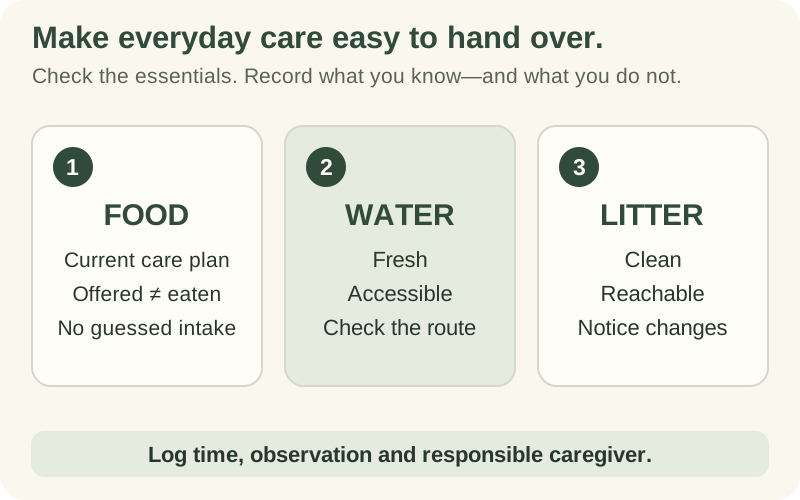
Use a complete, balanced diet suitable for the cat’s life stage and any veterinarian-directed needs. Fresh water must remain available. The right amount and feeding pattern depend on the individual; this lesson does not set calories, change a prescribed diet or recommend supplements. Account for food used in games and training within the existing feeding plan. Do not withhold meals to improve participation. For diet restrictions or difficulty eating, ask the veterinary team which rewards and enrichment are appropriate.
Make the toilet easy to reach
A common starting point is one litter box per cat plus an extra, distributed in separate accessible locations rather than lined up as one station. Quiet access, room to turn, suitable litter and regular cleaning matter too. Choose entrances the cat can manage and keep food and water away from toileting areas. A number alone cannot solve a blocked route. Retain a familiar usable box when offering a change; do not replace every box or litter type as a sudden experiment.
Write a useful handoff
Imagine two caregivers both assume the other has fed the cat. A simple record can prevent this: time, food offered, food left, water checked, litter scooped and anything unusual. Describe what you can see without claiming an exact intake you did not measure. In a shared litter box, write ‘cat identity unknown’ when appropriate. Do not isolate cats, restrict water or create stress just to complete a chart. Agree who checks the record and who calls the veterinarian.
Know when the routine is no longer routine
Repeated attempts to urinate with little or no urine can indicate a life-threatening obstruction: seek emergency veterinary care immediately. Do not assume straining is constipation or wait for a worksheet trend. If your cat stops eating, call the veterinarian promptly rather than using hunger to motivate them. New toileting outside the box, changed drinking or bowel habits also deserves veterinary discussion. Record timing and observations, but do not diagnose the cause or try a home treatment.
Try it gently
A daily-care handoff rehearsal
- Complete ws-care-03 using your current veterinarian-approved routine, or the fictional example ‘one adult cat, existing diet unchanged.’
- List who offers food, refreshes water and checks litter; assign a backup adult.
- Walk the routes while the cat is elsewhere and note noise, stairs or possible blocking.
- Write one sample entry that distinguishes offered food from observed eating.
- Practice the message: ‘I noticed [specific change], starting [time]. What should I do and how urgently?’
- Store veterinary and after-hours contact details where caregivers can find them; do not share personal information in a class discussion.
Pause or stop when
- Straining to urinate with little or no output: stop the lesson and seek emergency veterinary care now.
- Refusal to eat or a marked change in eating, drinking or elimination: contact the veterinarian promptly.
- Do not change medications, therapeutic diets or fluid intake as a worksheet experiment.
Knowledge check
Check your understanding
Try each question, then review the explanation. You can try again as often as you like.
Completion records this knowledge check. It is not an instructor-verified assessment or permission for practical work.
Reflect on your practice
Assess your observation, reasoning and planning, never a cat’s obedience. A fictional case or a decision to stop can demonstrate learning. Quiz results remain separate.
Choose your reflection descriptors
Help improve this lesson
Lesson sources
- Feeding Your CatCornell University College of Veterinary Medicine, Feline Health Center
- Everything You Should Know About Litter BoxesFelineVMA / Cat Friendly Homes
- Feline Lower Urinary Tract DiseaseCornell University College of Veterinary Medicine, Feline Health Center
- Cat Not Eating Normally Requires Medical CareFelineVMA / Cat Friendly Homes