Everyday care & enrichment / Lesson
care-04 · 25 min study time
Offer play and easy foraging without pressure
Design short, adaptable play invitations and an easy food-search activity while protecting normal feeding and rest.
Lesson duration includes reading, planning, worksheets and reflection. Optional cat practice is brief, voluntary and stops at the first sign of discomfort; the listed minutes are never a confinement or handling target.
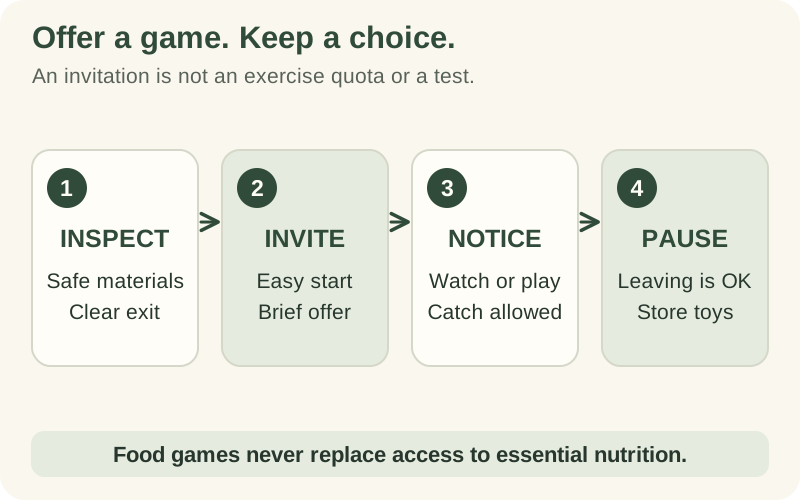
Pause and recall
What is the smallest invitation you can offer safely?
Offer the game the cat can choose
Play can give a cat opportunities to watch, stalk, chase and catch. Different cats prefer different movements and times. Move a suitable toy away from the cat, with pauses, instead of repeatedly pushing it toward their face. Let the cat catch it periodically. Watching can be part of participation; every invitation need not produce a sprint or jump. Use a toy rather than hands or feet, and choose floor-level movement when high activity is unsuitable.
Small is a sensible starting point
Begin with a very short invitation, perhaps a minute, and end sooner if the cat disengages. This is a starting option, not a daily exercise prescription. A toy moving slowly behind the edge of a sturdy box may interest one cat; another may prefer a soft toy to bat nearby. Record what happened and offer a different option another time. Repeatedly increasing speed because the cat has stopped responding turns observation into pressure.
Make food-search success easy
Use only an appropriate small portion from the cat’s existing food plan. An easy starting activity is a few visible pieces on a clean, shallow, stable surface with normal food still available. Do not make the cat solve a puzzle to receive essential nutrition. Increase only one difficulty after comfortable voluntary use, such as slightly greater spacing. For wet food or a prescribed diet, choose a washable setup approved for that food and follow its storage guidance. Remove leftovers appropriately.
Inspect, supervise and put away
Before and after use, check for loose parts, damage and pieces that could be swallowed. Store string, ribbon and wand toys out of reach when you are not supervising; an object being cheap or sold as a cat toy does not make it safe for unattended use. Keep loose packaging and handles out of homemade activities. If play causes distress, stop. Open-mouth or labored breathing, collapse or injury needs urgent veterinary attention, not a fitness explanation.
Try it gently
One invitation, one observation, one adjustment
- On ws-care-04 choose either a toy game or an easy food-search activity; you do not need to do both.
- Inspect the materials and clear a non-slip area with an exit path. Keep other animals away without stressful confrontation.
- Write a tiny starting plan and a stopping point before inviting the cat.
- Offer the activity briefly and allow watching, participation or departure. Do not move the cat into position.
- Record the actual response and put the materials away safely.
- Plan one easier or different option for next time; change no more than one feature so the observation remains interpretable.
Pause or stop when
- Leaving, repeated avoidance, tense freezing, agitation or food refusal during the game: stop and reassess.
- Chewing off pieces, tangling or unsafe equipment: remove the activity safely.
- Labored/open-mouth breathing, collapse or injury: seek emergency veterinary care.
Knowledge check
Check your understanding
Try each question, then review the explanation. You can try again as often as you like.
Completion records this knowledge check. It is not an instructor-verified assessment or permission for practical work.
Reflect on your practice
Assess your observation, reasoning and planning, never a cat’s obedience. A fictional case or a decision to stop can demonstrate learning. Quiz results remain separate.
Choose your reflection descriptors
Help improve this lesson
Lesson sources
- Cats and PlayCats Protection
- Playing With Your CatFelineVMA / Cat Friendly Homes
- Feeding Your CatCornell University College of Veterinary Medicine, Feline Health Center
- Help! Is This a Pet Emergency?AAHA