Everyday care & enrichment / Lesson
care-05 · 30 min study time
Support scratching and peaceful access in shared homes
Work with normal scratching and notice subtle competition without forcing cats to share or interact.
Lesson duration includes reading, planning, worksheets and reflection. Optional cat practice is brief, voluntary and stops at the first sign of discomfort; the listed minutes are never a confinement or handling target.
Pause and recall
Where could one cat block another cat’s only route?
Give scratching a workable place
Scratching serves normal feline functions including stretching, claw maintenance and marking. The aim is to provide suitable outlets, not eliminate the behavior. Notice whether your cat chooses a horizontal, angled or upright surface and where it is located. Offer a stable scratcher near a chosen area, leaving enough room for the movement. Reward voluntary use with something the cat enjoys; do not hold their paws against it or punish use of another surface.
Look beyond obvious fighting
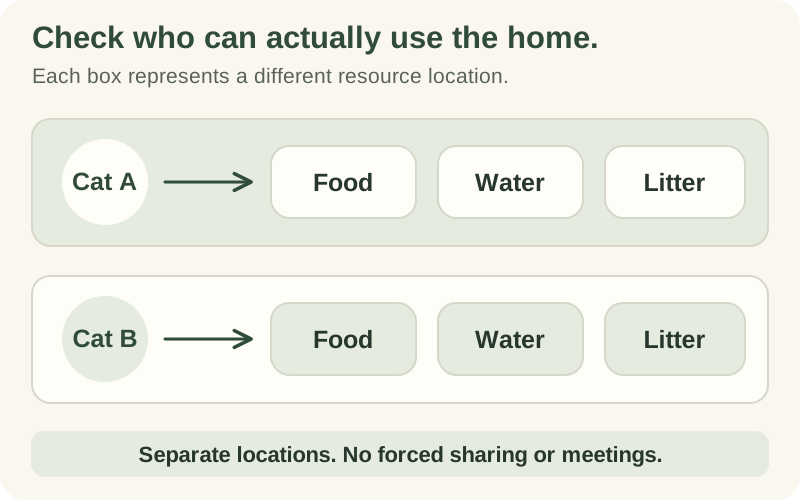
Cats sharing an address do not necessarily want to share every resource. Repeated staring, blocking a passage, chasing that is not reciprocated, hiding or giving up a resting place can signal tension. A peaceful-looking room may still contain a cat who waits until another leaves to eat. Observe each cat’s access independently. The goal is comfortable coexistence, not a photograph of cats sleeping together or a deadline for friendship.
Use the map to reduce a bottleneck
In this fictional example, Pip rests in a hallway while Nori approaches the only water station, pauses and retreats. The observation does not establish motive or a social rank. Mark the hallway and add a separate water option where Nori already moves comfortably. Preserve Pip’s access too. Check whether the new choice is actually usable, and record both cats’ responses. Household design changes should not involve cornering a cat or placing resources so close that another animal can guard them all.
Keep people out of confrontations
Do not make cats ‘work it out,’ arrange forced meetings or place your hands between fighting animals. If conflict is occurring, prioritize distance and safe separation without handling aroused cats; ask a veterinarian for a plan and qualified behavior support. A new or escalating change may have a medical component. This lesson does not provide a full introduction or aggression-treatment protocol. A safe separate space must still provide the cat’s essential resources and humane care.
Try it gently
Scratch-and-access audit
- Use ws-care-05 to record one scratching preference and, if relevant, one shared-resource route.
- Observe at a distance at an ordinary time; do not provoke a chase or bring cats together.
- Describe each cat’s path and the order of events rather than assigning blame.
- Choose either a stable scratching option or an additional separated resource; check that it helps without trapping another cat.
- Set a review time and write what improved access would look like, such as using water without retreating.
- If conflict or avoidance persists, take your factual notes to your veterinarian rather than repeatedly rearranging the home.
Pause or stop when
- Staring escalates into stalking, cornering, chasing, hissing or fighting: stop the exercise and prioritize safe distance.
- Do not touch, pick up or put hands between aroused cats.
- Injury, sudden behavior change or inability to reach essentials: seek veterinary advice promptly; urgent injury needs emergency care.
Knowledge check
Check your understanding
Try each question, then review the explanation. You can try again as often as you like.
Completion records this knowledge check. It is not an instructor-verified assessment or permission for practical work.
Reflect on your practice
Assess your observation, reasoning and planning, never a cat’s obedience. A fictional case or a decision to stop can demonstrate learning. Quiz results remain separate.
Choose your reflection descriptors
Help improve this lesson
Lesson sources
- Cat ScratchingFelineVMA / Cat Friendly Homes
- Intercat TensionFelineVMA / Cat Friendly Homes
- Cats and FightingCats Protection
- Setting Up the Environment for SuccessFelineVMA