Kind training, step by step / Lesson
training-01 · 25 min study time
Choose rewards and set up a willing learner
Prepare short, voluntary practice around what your individual cat values today.
Lesson duration includes reading, planning, worksheets and reflection. Optional cat practice is brief, voluntary and stops at the first sign of discomfort; the listed minutes are never a confinement or handling target.
Pause and recall
What evidence tells you this reward is useful to this cat?
Define what you want to see
Write one observable action: ‘looks toward the mat’ is clearer than ‘behaves better.’ Positive reinforcement means an outcome the cat values follows an action and helps that action occur again. Calling something a treat does not make it rewarding for every cat. Training is a shared activity, not a test of dominance or affection. A cat who opts out has given useful information about the setting, activity or their comfort.
Let the cat’s response guide the choice
Possible rewards include suitable food, a brief favorite toy game or welcomed social contact. Offer a low-pressure choice at separate moments and notice whether the cat engages and returns willingly. Preferences can change. Do not keep touching a cat because petting is your preferred reward. If food is used, follow the existing feeding plan and any veterinary restrictions. Ordinary meals, water, resting places and affection are never withheld to create motivation.
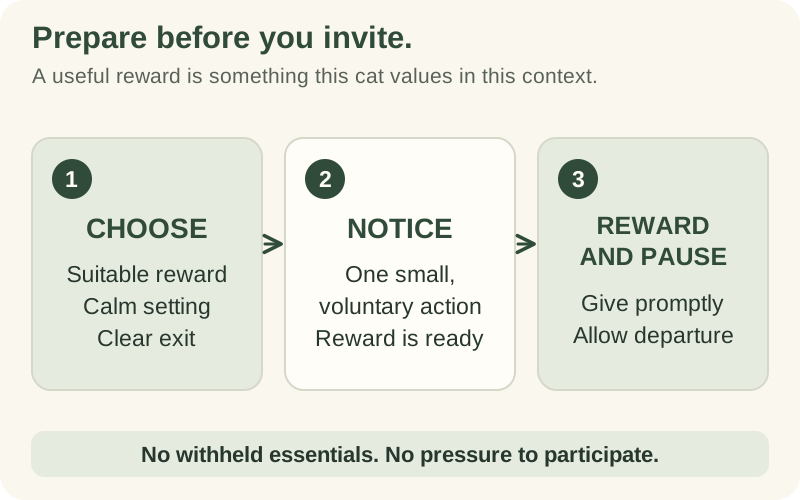
Prepare before inviting
Have the reward ready and the practice area clear before starting. Work with one cat at a time in a familiar, calm setting without creating distress through separation. Check that the cat is awake, comfortable and able to leave. For a first session, plan a brief invitation and an easy ending, with time to record afterward. The lesson’s study duration includes your reading and planning; it is not a target length for the cat’s training.
Use the record to change your plan
Imagine Arun offers a toy after his cat glances at a towel. The cat walks away. His note should not read ‘failed training.’ It can read ‘looked at towel; toy offered; moved to window.’ Next time Arun might change the timing, place or reward, but only one feature. If the cat seems unwell, painful or unusually withdrawn, the next step is veterinary advice rather than a more tempting reward. Never use yelling, sprays, startling, scruffing or physical positioning as a teaching shortcut.
Try it gently
A reward and readiness check
- Complete ws-training-01 with one tiny goal and two possible rewards compatible with the cat’s care plan.
- Prepare the quiet area and make an exit route obvious. Rehearse reward delivery without the cat.
- If the cat voluntarily joins, offer one possible reward and observe the response; do not insist on a behavior yet.
- At another comfortable moment, offer the alternative. Stop earlier if the cat is done.
- Record the context and what the cat actually chose, including no participation.
- Select a starting reward and one reason you would postpone the next session.
Pause or stop when
- Hiding, tense posture, growling, avoidance or leaving: end the invitation.
- Unusual refusal of normally valued food, pain signs or illness: stop training and seek veterinary advice.
- Food restrictions or uncertainty about a reward: clarify with the veterinarian before using it.
Knowledge check
Check your understanding
Try each question, then review the explanation. You can try again as often as you like.
Completion records this knowledge check. It is not an instructor-verified assessment or permission for practical work.
Reflect on your practice
Assess your observation, reasoning and planning, never a cat’s obedience. A fictional case or a decision to stop can demonstrate learning. Quiz results remain separate.
Choose your reflection descriptors
Help improve this lesson
Lesson sources
- How Cats LearnFelineVMA
- Positive Reinforcement Techniques to Prevent Unwanted BehaviorsFelineVMA
- Feeding Your CatCornell University College of Veterinary Medicine, Feline Health Center