Kind training, step by step / Lesson
training-02 · 25 min study time
Make a marker clear: timing, reward, pause
Practice the caregiver’s timing first, then introduce a quiet marker that reliably predicts a reward.
Lesson duration includes reading, planning, worksheets and reflection. Optional cat practice is brief, voluntary and stops at the first sign of discomfort; the listed minutes are never a confinement or handling target.
Pause and recall
Where does the marker belong in the sequence?
A marker tells the cat which moment mattered
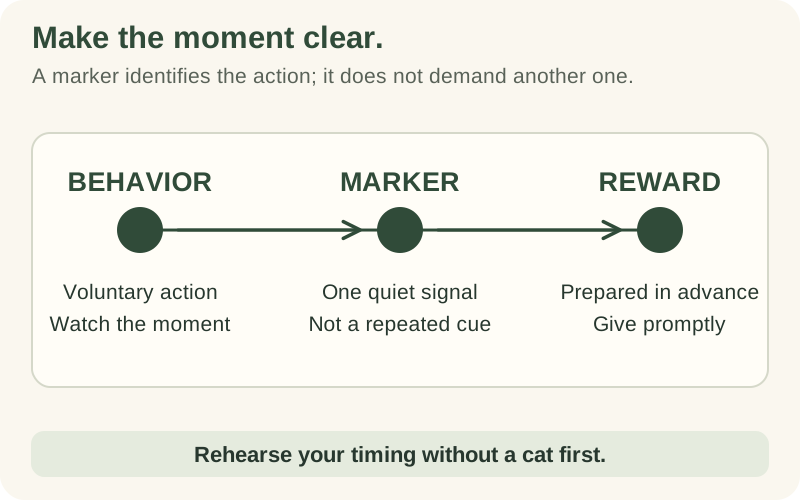
A marker is a brief sound or word paired with a reward. A cue asks for an already learned action; a marker identifies the moment being rewarded. Choose one quiet, consistent signal that does not startle your cat. A clicker is optional. Introduce the marker by giving it once and immediately following with the chosen reward, without asking for a trick. Keep each pairing simple and stop while the cat is comfortable.
Practice the human part separately
Use a spoon, cup or moving dot on paper as your rehearsal target. A partner moves the object; you say your marker at an agreed moment and place a token in a cup. The purpose is to notice delays, not to achieve a speed record. Prepare the reward before you mark. If your hands are occupied, arrange the materials differently. A seated position, stable dish or helper can make the sequence easier without adding equipment.
From pairing to one easy action
After the cat comfortably anticipates the reward, you can mark a simple voluntary action, such as looking at an already familiar towel. Mark the moment, provide the reward, then pause. Do not repeat the marker louder to demand a response, and do not mark several times while searching for the reward. If you mark accidentally, still provide the promised reward and simplify your setup. You are building a dependable pattern, not testing whether the cat can tolerate uncertainty.
Decide what the result actually means
In a fictional practice, Jo marks after the cat has already turned away from the towel. That does not prove the cat misunderstood; the timing itself was unclear. Jo notes ‘marker late’ and rehearses without the cat before trying again. If the cat startles at the sound, stop and use a quieter approach later rather than repeating it until the cat gives up reacting. Lack of obvious progress is a reason to review the plan, not increase repetitions indefinitely.
Try it gently
Marker rehearsal and a brief optional pairing
- On ws-training-02 write the chosen marker and the reward sequence in your own words.
- Without a cat present, rehearse several object-and-token rounds; note whether the reward was ready and the marker matched the event.
- If a comfortable cat voluntarily joins, offer one quiet marker followed immediately by the prepared reward.
- Pause to observe. Offer another pairing only if the cat remains relaxed and interested; a few comfortable pairings are enough for a first attempt.
- End without adding a harder task and record any timing difficulty or startle response.
- Choose one practical improvement for your next rehearsal; repeat the human practice whenever needed.
Pause or stop when
- Startling at the marker, tense freezing, retreat or refusal to engage: stop.
- Do not amplify, repeat rapidly or use the marker to interrupt or frighten the cat.
- If a sound or handling response changes unexpectedly, seek veterinary guidance rather than assuming disobedience.
Knowledge check
Check your understanding
Try each question, then review the explanation. You can try again as often as you like.
Completion records this knowledge check. It is not an instructor-verified assessment or permission for practical work.
Reflect on your practice
Assess your observation, reasoning and planning, never a cat’s obedience. A fictional case or a decision to stop can demonstrate learning. Quiz results remain separate.
Choose your reflection descriptors
Help improve this lesson
Lesson sources
- Cat Training Techniques for CaregiversFelineVMA
- How Cats LearnFelineVMA
- Cat training 101AAHA