Kind training, step by step / Lesson
training-03 · 30 min study time
Build a voluntary target and a comfortable mat
Use tiny steps to teach a nose target or resting station, with a genuine option to leave.
Lesson duration includes reading, planning, worksheets and reflection. Optional cat practice is brief, voluntary and stops at the first sign of discomfort; the listed minutes are never a confinement or handling target.
Pause and recall
What is an easier step than the one you first planned?
Start with one skill
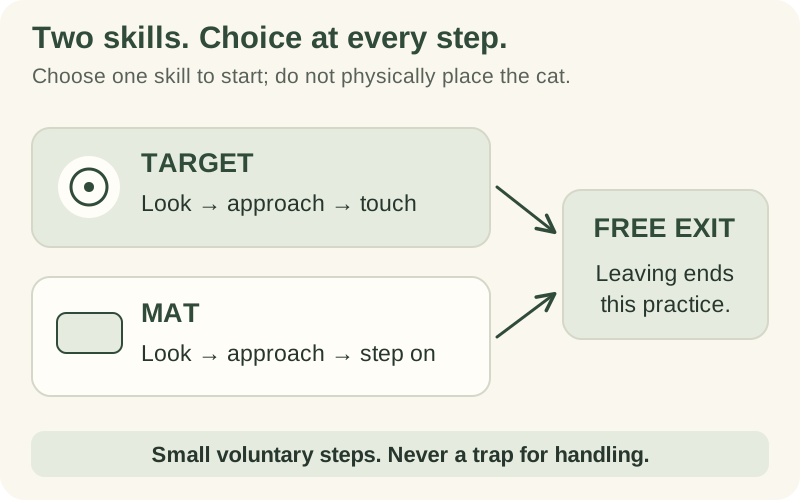
Targeting means teaching the cat to touch a presented object, commonly with their nose. Stationing means choosing a particular place such as a mat. They can later support everyday care, but start with one so you can keep the signal clear. Use a clean, smooth, safe target or a stable non-slip mat in a familiar area. Do not use a sharp stick, press anything into the cat’s face or place them bodily on the mat.
Make the first step easy to notice
For a target, reward a voluntary look or investigation before requiring a touch if needed. For a mat, a glance or a step toward it can be the starting action. Mark and reward one clear event, then pause. Increase only a small part of the task when the current step is comfortable and repeatable. If the cat hesitates or leaves, go back to an easier arrangement on a later occasion. A fixed repetition count does not prove readiness.
Keep position and duration separate
Once stepping onto a mat is comfortable, a brief pause on it can be rewarded before asking for more time. Deliver the reward where you want the comfortable behavior to happen, without holding the cat there. Add a simple cue only after the action is predictable; repeating a word does not teach the action by itself. Never use the mat as a trap for an unpleasant procedure. Moving away always ends this optional practice.
Work through a small example
Lena wants her cat to stand on a towel near a scale eventually. Today she leaves the scale out of the exercise. She records ‘look toward towel,’ then ‘one paw on towel,’ instead of treating ‘stand on scale’ as a single demand. If the towel slides, she fixes the equipment without the cat present. If her cat walks around it, she records that route and checks texture or location. The worksheet tracks changes to the task, not a score for the cat.
Try it gently
A four-step learning ladder
- Choose target OR mat on ws-training-03 and describe the eventual everyday purpose.
- Write four possible small steps, including an easier starting point and a retreat option. These are options, not a same-day checklist.
- Inspect and position the target or mat, with space to leave and no other care procedure waiting.
- If the cat joins comfortably, mark and reward the easiest voluntary action you can observe.
- End after a brief comfortable attempt, even if the action was only looking. Do not combine distance and duration increases.
- Record the last comfortable step and the next easier step you would use if needed.
Pause or stop when
- Avoidance, startle, tension or leaving: end the attempt.
- Sliding equipment or a chewable/sharp target: remove and fix the setup.
- Do not use targeting to lead a cat toward something they are already showing fear of.
Knowledge check
Check your understanding
Try each question, then review the explanation. You can try again as often as you like.
Completion records this knowledge check. It is not an instructor-verified assessment or permission for practical work.
Reflect on your practice
Assess your observation, reasoning and planning, never a cat’s obedience. A fictional case or a decision to stop can demonstrate learning. Quiz results remain separate.