Kind training, step by step / Lesson
training-04 · 30 min study time
Make the open carrier an ordinary choice
Create a stable carrier setup and a patient entry plan that never turns a reward into a trap.
Lesson duration includes reading, planning, worksheets and reflection. Optional cat practice is brief, voluntary and stops at the first sign of discomfort; the listed minutes are never a confinement or handling target.
Pause and recall
What will you keep unchanged when the cat first enters?
Choose and prepare the carrier
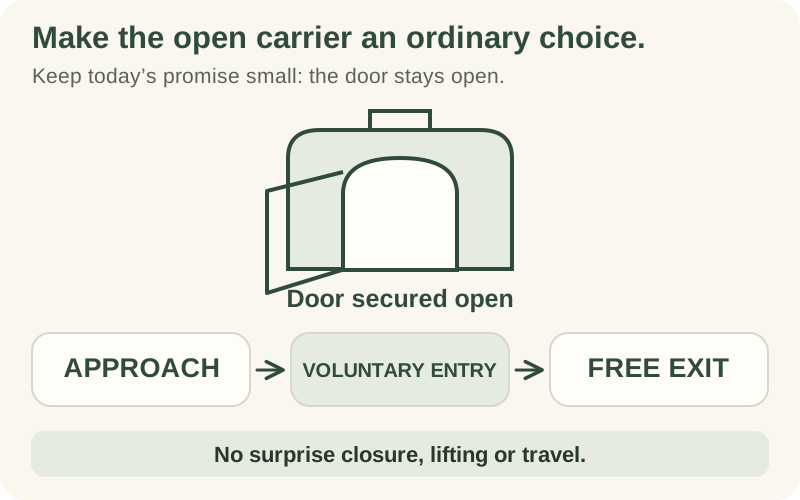
Use a secure, well-ventilated carrier suited to the cat’s size and the journey. Features such as a removable top can help the veterinary team examine a cat without pulling them out. Check latches, fittings and carrying instructions; a household box used for hiding is not a travel carrier. Put the carrier on a stable surface at home, with familiar comfortable bedding if suitable. Secure the door fully open so it cannot swing shut unexpectedly.
Treat approach as part of learning
Leave the carrier available in a familiar space rather than bringing it out only before a difficult trip. Comfortable looking, approaching or resting nearby can be useful first steps. Offer an appropriate reward where the cat is already comfortable, gradually building toward voluntary entry. If entry is too much, remain at approach. Do not put all essential food inside an unfamiliar carrier or push from behind. The cat must be free to reverse or leave.
Keep today’s promise small
This lesson is open-door practice only. Closing the door because the cat finally entered changes the agreement and can damage the learning plan. Write ‘door stays open’ on the worksheet. In the fictional case of Tomas and Fern, Fern puts two paws inside and backs out. Tomas records two paws as the last comfortable step. He does not move the reward deeper, block the opening or repeatedly call her back. Progress can take multiple sessions over days or weeks.
Have a separate urgent-care plan
Carrier preparation should start when there is no immediate medical deadline. If the cat needs veterinary attention before training is complete, contact the clinic for safe transport guidance; do not delay necessary care to finish this course. Tell the team about fear, prior handling problems and carrier type. Do not prescribe sedatives or borrow another animal’s medication. The veterinary team can make an individualized plan; this lesson cannot guarantee stress-free travel.
Try it gently
An open-door carrier plan
- Complete ws-training-04 with the carrier’s features, condition and manufacturer’s carrying instructions.
- Prepare stable bedding and secure the door open; rehearse assembly without the cat.
- List approach steps from noticing the carrier to voluntary entry, including a step outside it.
- If the cat joins, reward a comfortable action at the easiest step. Keep the door open throughout.
- Record voluntary entry and exit separately; leaving is allowed and is not a failed trial.
- Write the clinic’s contact route and your plan for asking for help if a visit is needed before training is complete.
Pause or stop when
- Avoidance, tense crouching, attempts to escape or distress: stop and return to a less demanding plan later.
- Loose fittings, unstable base, door movement or damaged carrier: stop and repair or replace before use.
- Current illness or urgent care need: stop the training plan and contact the veterinary team.
Knowledge check
Check your understanding
Try each question, then review the explanation. You can try again as often as you like.
Completion records this knowledge check. It is not an instructor-verified assessment or permission for practical work.
Reflect on your practice
Assess your observation, reasoning and planning, never a cat’s obedience. A fictional case or a decision to stop can demonstrate learning. Quiz results remain separate.
Choose your reflection descriptors
Help improve this lesson
Lesson sources
- Getting Your Cat to the Veterinarian: Reducing the Stress of Veterinary VisitsAAFP / ISFM (hosted by FelineVMA)
- Choosing the Perfect Cat CarrierFelineVMA / Cat Friendly Homes
- Getting Your Cat to the VeterinarianFelineVMA / Cat Friendly Homes