Kind training, step by step / Lesson
training-05 · 30 min study time
Add carrier-door movement and plan a calm journey
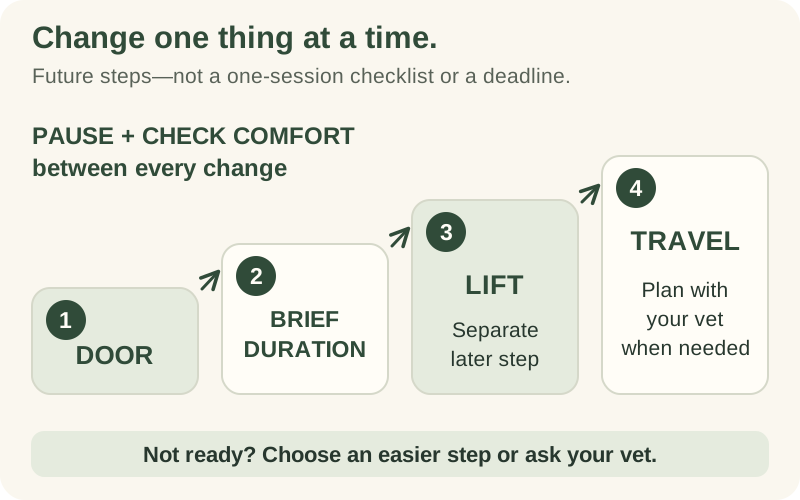
Separate door movement, brief closure and transport into distinct steps, with veterinary help when preparation is difficult.
Lesson duration includes reading, planning, worksheets and reflection. Optional cat practice is brief, voluntary and stops at the first sign of discomfort; the listed minutes are never a confinement or handling target.
Pause and recall
Which variables are you accidentally changing together?
Check the prerequisite honestly
Begin only if open-carrier entry and exit are already comfortable. A cat who rushes out, crouches tensely or avoids the carrier has not shown readiness for closure. Continue an easier step instead. Repeated exposure that feels threatening can increase fear; staying until the cat becomes motionless is not the aim. The duration listed for this lesson is study time, not a confinement goal.
Break the door task apart
Door movement can begin as a tiny movement while the cat is relaxed nearby and able to leave. Later, comfortable voluntary entry can be paired with a small door movement, then an immediate return to open. Only when those steps remain comfortable should a very brief closure be considered, reopening before distress. Do not increase movement, closure duration and lifting together. If the cat shows discomfort, safely reopen while containing the cat in the room, give space and end practice; do not wait for silence as a condition of release.
Write the journey plan before adding the journey
Ask the clinic how to prepare for arrival and tell them what your cat finds difficult. Follow the carrier and vehicle manufacturers’ secure-transport instructions; suitability and crash testing are product-specific. Keep the cat contained during transport, maintain ventilation and a comfortable temperature, and never leave the cat unattended in a vehicle. A cover may reduce visual stimulation for some cats if it does not obstruct airflow, but it is not mandatory. Do not open a carrier beside traffic or in an unsecured space.
Keep a record that supports a decision
A fictional record reads: ‘Door moved a few centimeters; cat stayed loose-bodied; reward accepted; door returned open.’ That supports repeating the same small step, not a conclusion that an hour-long trip will be easy. Record a separate entry for any new task. If the cat has a strong fear history, cannot settle or needs repeated visits, ask the veterinary team for individualized support. Do not use this course to choose or dose medication. After a visit, allow a quiet return and monitor other animals’ reactions.
Try it gently
A single-variable next-step plan
- On ws-training-05 record the last comfortable open-carrier behavior; if it is not established, return to training-04.
- Choose one tiny change only: door movement OR a planning rehearsal without the cat.
- Write your immediate reopening and stopping plan before starting.
- Practice only while the cat is comfortable and free to opt out; keep any closure brief and safely reversible.
- Record exactly what moved, approximate duration, posture and whether the cat voluntarily re-engaged. Do not chase a better result.
- Complete the transport checklist and questions for the veterinary team separately from the cat’s practice.
Pause or stop when
- Rushing, pawing to escape, freezing, hissing or escalating vocalization: safely end the practice and reduce the next step.
- Open-mouth/labored breathing or collapse: urgent veterinary care, not further desensitization.
- An imminent required journey with an unready cat: ask the clinic for guidance; do not rush through the training ladder.
Knowledge check
Check your understanding
Try each question, then review the explanation. You can try again as often as you like.
Completion records this knowledge check. It is not an instructor-verified assessment or permission for practical work.
Reflect on your practice
Assess your observation, reasoning and planning, never a cat’s obedience. A fictional case or a decision to stop can demonstrate learning. Quiz results remain separate.
Choose your reflection descriptors
Help improve this lesson
Lesson sources
- How Cats LearnFelineVMA
- Getting Your Cat to the Veterinarian: Reducing the Stress of Veterinary VisitsAAFP / ISFM (hosted by FelineVMA)
- Choosing the Perfect Cat CarrierFelineVMA / Cat Friendly Homes
- Getting Your Cat to the VeterinarianFelineVMA / Cat Friendly Homes
- Help! Is This a Pet Emergency?AAHA