Everyday care & enrichment / Lesson
care-01 · 25 min study time
Notice first: learn your cat’s everyday signals
Build an observation habit that separates what you see from what you assume, and lets your cat choose whether to interact.
Lesson duration includes reading, planning, worksheets and reflection. Optional cat practice is brief, voluntary and stops at the first sign of discomfort; the listed minutes are never a confinement or handling target.
Pause and recall
What did you actually observe, and what remains uncertain?
Start with the whole scene
A tail movement alone is not a mood diagnosis. Look at the cat’s body, ears, movement and distance from people, then look at the setting. A crouch during a toy game may mean something different from a crouch beside a noisy appliance. Relaxed movement, an unhurried approach and the ability to leave are useful context; tense stillness is not proof of comfort. If you cannot tell whether a cat welcomes contact, choose the less intrusive option: give space.
Write observations, then possibilities
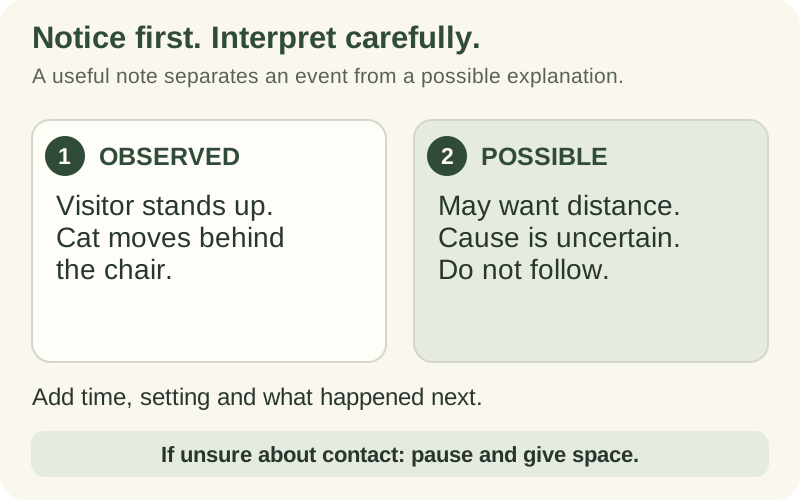
Use two columns: observed and possible explanation. ‘Mina moved behind the chair when a visitor stood up’ is an observation. ‘Mina hates visitors’ is a claim the observation cannot establish. Add the time, what happened just before, how close the person was and what the cat did next. You do not need to follow Mina behind the chair to get a better record. A useful note can end with ‘out of view; left undisturbed.’
Make contact an invitation
When an awake cat voluntarily approaches, remain still and give them room. If familiar gentle cheek contact is welcomed, keep it brief, remove your hand and notice what happens. Continuing contact requires continuing comfort; an approach is not permission for picking up, belly touching or prolonged stroking. If the cat turns away, moves off, stiffens, flattens their ears, swishes their tail sharply, hisses or growls, stop. Do not follow them to obtain a better interaction.
A baseline is a comparison, not a diagnosis
Choose ordinary moments such as waking, meals and quiet evening time. Record normal variation rather than trying to produce a perfect behavior. Over several days, your notes may reveal that one chair is preferred or one doorway is avoided. New withdrawal, changed appetite, difficulty moving or an unusual reaction to touch warrants veterinary advice, even if you recently changed the room. Do not test a painful area or reproduce distress for a video. A worksheet is a conversation aid, not a health screening tool.
Try it gently
A quiet observation and an optional invitation
- Prepare ws-care-01 and sit at a comfortable distance without calling or approaching the cat.
- Watch one ordinary awake moment for up to two minutes; record posture, movement and the surrounding event.
- Separate three things actually observed from one tentative explanation. ‘I do not know’ is valid.
- If the cat independently approaches and already enjoys brief cheek contact, offer one short familiar interaction and pause. Otherwise observe only.
- Record whether the cat chose to stay, leave or resume contact. Do not repeat to change the result.
- Write one practical adjustment, such as asking visitors to sit quietly, and one change you would discuss with a veterinarian.
Pause or stop when
- The cat leaves, hides, freezes, becomes tense, hisses or attempts to swat: end the interaction and give space.
- A new pain response, appetite change or mobility change: pause practice and contact a veterinarian.
- Breathing difficulty or collapse: seek emergency veterinary care immediately.
Knowledge check
Check your understanding
Try each question, then review the explanation. You can try again as often as you like.
Completion records this knowledge check. It is not an instructor-verified assessment or permission for practical work.
Reflect on your practice
Assess your observation, reasoning and planning, never a cat’s obedience. A fictional case or a decision to stop can demonstrate learning. Quiz results remain separate.
Choose your reflection descriptors
Help improve this lesson
Lesson sources
- Cat body languagePDSA
- How to pet a catCats Protection
- Signs of Pain in Cats: How to Tell If Your Cat Is HurtingAmerican Animal Hospital Association (AAHA)